The monthly calendar, what each day did
On this page
The Monthly tab shows a place's month as a calendar. Days that have passed show what happened: the high, the low and any rain or snow. Days ahead show the forecast. Every day also shows what is normal for its date.
#Open the calendar
Open a U.S. place, then select Monthly. The tab is shown for places in the United States; places elsewhere do not have it. The Almanac box on the Today page has a Monthly link as well.
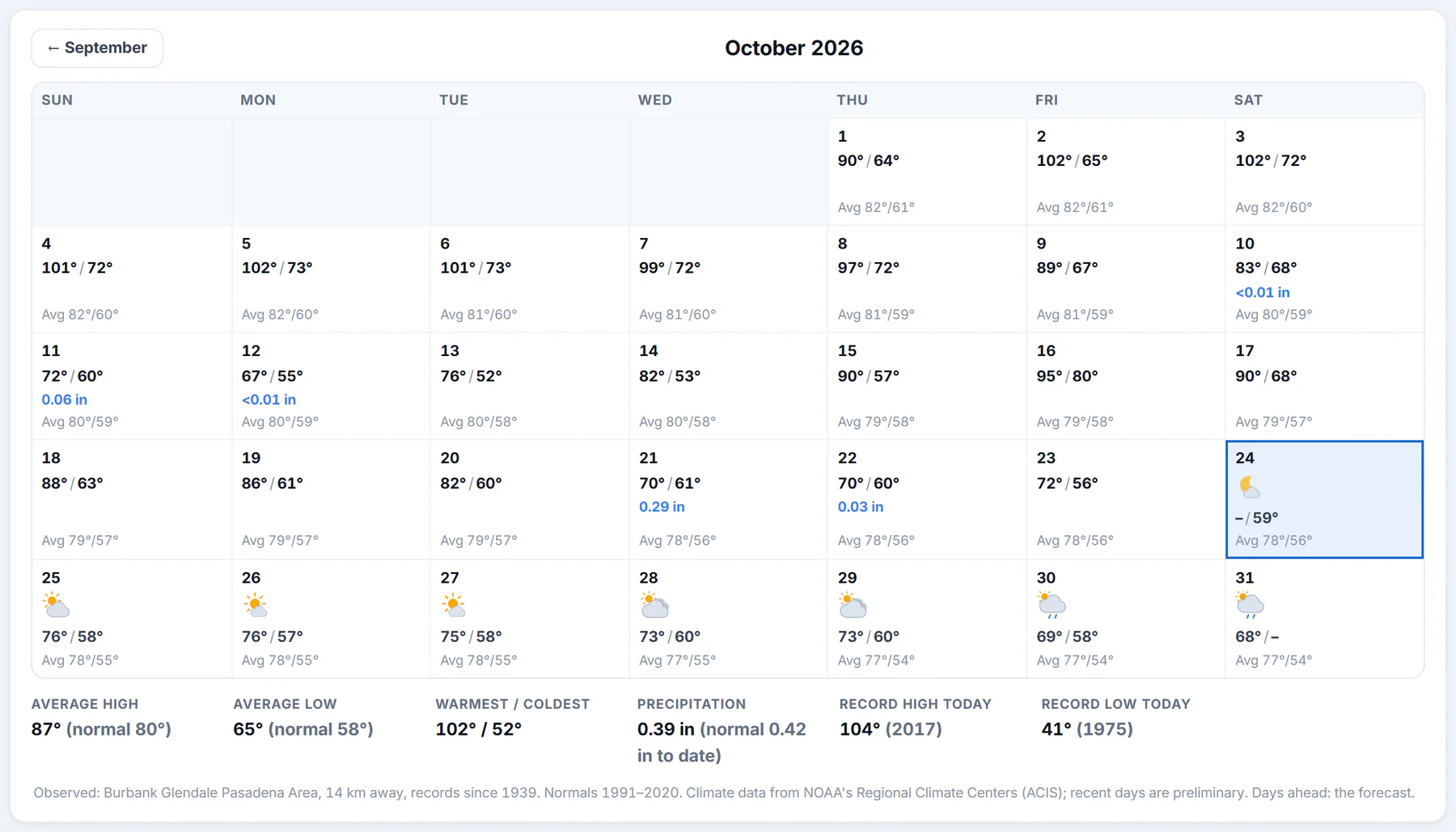
A month. The summary under the calendar compares the month so far with normal.
- 1Go to the month before
- 2A day that has happened: high, low and rain
- 3Today
- 4The normal high and low for that date
- 5The month so far, against normal
#Read the calendar
- Days that have passed show the day's high and low, with the rain or snow that fell under them.
- Today is outlined.
- Days ahead show an icon and the forecast's high and low.
- Every day carries a small line such as Avg 82°/61°: the normal high and low for that date.
Below the calendar, a summary compares the month so far with normal:
| Figure | What it says |
|---|---|
| Average high and Average low | The mean of the days so far, with the normal beside it |
| Warmest / coldest | The highest high and the lowest low so far |
| Precipitation | The month's total so far, against what is normal to this date |
| Record high today and Record low today | The records for today's date, with the year each was set. Shown on the current month |
#Move between months
The button at the left of the month's title goes to the month before. On a past month, a button at the right goes to the month after. You can look back about two years. The calendar returns to the current month if you ask for a date beyond that.
#Where the numbers come from
A note under the summary names the climate station behind them, for example "Burbank Glendale Pasadena Area, 14 km away, records since 1939". Observed days are from NOAA's regional climate centers, from the nearest station with a long record, which may be a few miles from the place. Normals are the 1991 to 2020 averages. Recent days are preliminary and can be corrected later.
If no long-record station is near the place, the page says so and shows only the forecast.
#Common questions
What are normals?
They are the average high, low and rain for a date over the 30 years from 1991 to 2020. A day that is warmer than normal is above that average.
Why do the numbers differ from my own thermometer?
The calendar uses the nearest long-record climate station, which can be some distance away and at a different elevation.
Why does a past day have no rain figure?
Nothing measurable fell, or the station has not reported it yet. Recent days are preliminary.
Why is the Monthly tab missing for my place?
Monthly is for places in the United States. See Read a place's forecast page for what places elsewhere have.